





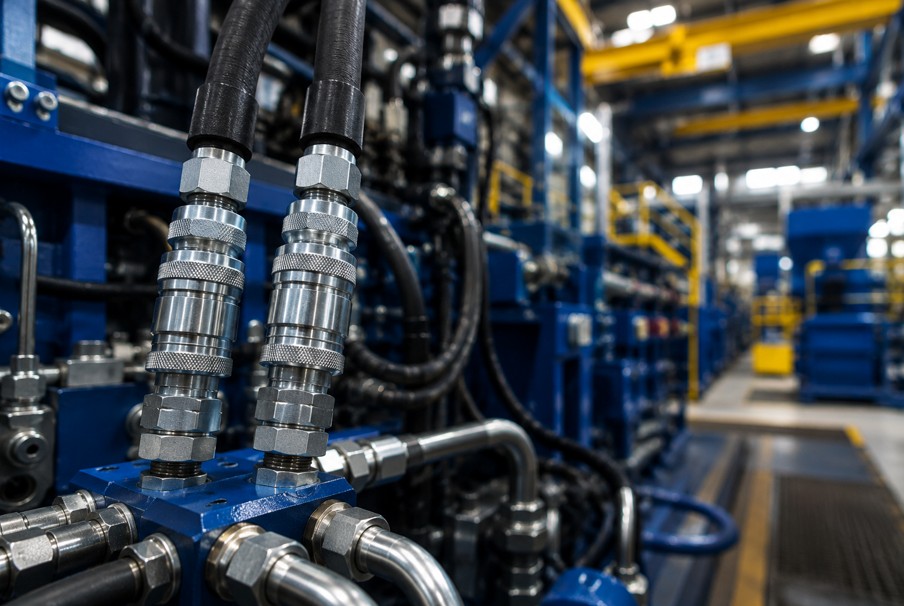
For many years, quick couplings were seen only as operational components within industrial lines. However, in a scenario where productivity, safety, energy efficiency, and reduced downtime are competitive priorities, this type of solution has come to occupy a much more strategic role within operations.
Today, industrial companies working with hydraulics, pneumatics, refrigeration, specialty fluids, and high-pressure systems are reviewing their processes to eliminate invisible losses that compromise production performance. And one of these losses lies precisely in inadequate, slow, or unsafe connections.
More than just connecting and disconnecting lines, modern quick couplings have come to represent operational gains, technical safety, and intelligent maintenance.
The problem that many industries still ignore.
Many Brazilian companies still operate with traditional connection systems, often improvised, worn out, or incompatible with the current level of demand in the industry.
In practice, this creates problems that go far beyond a simple connection change:
- Increased setup time;
- Excessive machine downtime;
- hydraulic leaks;
- loss of pressure;
- Fluid contamination;
- risk of accidents;
- premature wear and tear of equipment;
- increased maintenance costs;
- low operational productivity.
The most critical aspect is that many of these losses don't immediately appear in the financial terms. They emerge diluted in excessive corrective maintenance, rework, consumption of supplies, and loss of operational performance.
It is precisely at this point that industrial quick couplings gain technical prominence.
What the modern industrial market is looking for today
Industries have evolved. Technical requirements have also evolved.
Today, the market is looking for components that deliver:
- operational agility;
- high-pressure safety;
- efficient sealing;
- durability;
- ease of maintenance;
- technical compatibility;
- extreme resistance;
- Reducing downtime;
- Operational standardization.
Companies operating in sectors such as metalworking, agriculture, construction, mining, automation, oil and gas, road equipment, and heavy hydraulics need robust, reliable solutions prepared for continuous operation.
And that requires applied engineering.
When quick couplings stop being just a part and become a solution.
There is a huge difference between selling a component and delivering a technical solution.
Many companies supply standardized products. Few possess sufficient technical knowledge to properly guide complex industrial applications.
This is precisely where Dynamics Quick Couplings differentiates itself in the Brazilian market.
The company operates with a technical focus, possessing a deep understanding of industrial scenarios, operational requirements, and the challenges of each application.
More than just selling quick couplings, Dynamics works to deliver:
- operational performance;
- reliability;
- security;
- productivity gain;
- Reducing failures;
- maintenance efficiency.
This technical positioning has led the company to be recognized for serving critical applications and demanding industrial environments.
Engineering applied to the reality of industry.
Each industrial operation has its own particularities.
Working pressure, fluid type, temperature, operating cycles, vibration, abrasion, and application environment all directly influence the correct choice of a quick coupling.
When this choice is made inappropriately, problems quickly arise.
Therefore, industrial companies are increasingly seeking partners who can technically analyze their operations and recommend the best solution for each scenario.
Dynamics understands that industrial performance depends not only on the machine, but also on the intelligence of the components that make the system work.
The direct impact on productivity
Many companies still underestimate the operational impact of quick couplings.
But when we analyze modern production lines, we quickly realize how much this component influences efficiency.
Among the main gains perceived by the industries are:
Reduced setup time
Quick and secure exchanges reduce unproductive time and speed up processes.
Lower leakage rate
Efficient sealing reduces losses and increases operational safety.
Greater safety for operators
Proper connections reduce risks during maintenance and operations.
Operational standardization
It facilitates preventive maintenance and increases technical control.
Reducing hidden costs
Fewer downtimes, less rework, and a longer lifespan for systems.
Brazil is undergoing an industrial transformation.
Brazilian industry is undergoing a period of transformation.
Automation, energy efficiency, lean productivity, and intelligent maintenance are no longer differentiators. They have become competitive requirements.
In this new scenario, supplier companies need to deliver more than just products. They need to deliver technical knowledge, specialized support, and solutions that generate real operational results.
Dynamics Quick Couplings has been positioning itself precisely in this way: as a company prepared to serve modern industry with technical intelligence, reliability, and performance.
The future of industrial operations lies in the efficiency of the details.
Often, industrial competitiveness isn't just about large machines. It's in the details that underpin the entire operation.
Quick couplings are part of this new industrial logic.
These are the components that have a direct impact:
- productivity;
- security;
- performance;
- maintenance;
- operational time;
- efficiency of the systems.
Companies that understand this have a head start.
And it is precisely in this movement that Dynamics consolidates itself as a technical reference in the Brazilian market for industrial quick couplings.
